![]() |
![]() |
|
![]() |
|||||||||||||||||
| MANTRA
47 offers the process control engineer an advanced control system that is
extremely easy to use. Developed on the Allen-Bradley (A-B) 1747 (SLC) platform, MANTRA 47
is ideal for applications such as water treatment, chemicals processing, and heat
treatment. MANTRA 47 offers several advantages over traditional loop controller based systems, such as intuitive graphical programming techniques, a choice of over 80 powerful control function blocks, smart display faceplates, and, most importantly, the power of an integrated A-B PLC architecture. MANTRA 47 offers the control horsepower and reliability of a small DCS, which is ideal for process control applications and also provides a substantial cut in project costs because of lower engineering time and competitive system pricing. |
|||||||||||||||||
|
|||||||||||||||||
| Overview | |||||||||||||||||
| A Versatile Control Platform | If you're a process engineer looking for a
cost-effective yet advanced control system, ControlSoft's MANTRA 47 offers you a powerful,
versatile choice. The hardware platform of the MANTRA 47 process controller uses
Allen-Bradley's versatile 1747-OC Open Controller and 1746-based I/O and 1771 RIO
architecture.The MANTRA 47 controller is compatible with a wide range of A-B proprietary and open communication networks, simplifying integration with PLC programmable controllers, Panel View operator stations, HMI supervisory workstations, and other Allen-Bradley systems. And like traditional Allen-Bradley controls, the MANTRA 47 controller's modular, scalable architecture makes it easy to match control capability with application requirements. |
||||||||||||||||
| An Extremely Powerful Development Environment | Powerful process control functions are at the heart of the MANTRA 47
process development system. These functions were designed by process engineers for
continuous and batch process applications. An easy-to-use function block editor makes
selecting, linking, and configuring functions and I/O devices a simple drag and drop
process. The MANTRA 47 development system also provides ready-to-use operator system faceplates that are compatible with ActiveX-compliant HMI supervisory software packages. Creating process control programs has never been easier. |
||||||||||||||||
| Assured Architectural Compatibility | The MANTRA 47 system is an extremely powerful stand-alone process control system. However, it is easily integrated into systems that include Allen-Bradley PLC-5 programmable controller and associated HMI stations, because the MANTRA 47 controller looks like a PLC on the network. The MANTRA 47 controller's PLC-5 virtual data table (VDT) structure makes it possible to monitor process applications and raw material and finished goods handling from a single HMI supervisory workstation. | ||||||||||||||||
| Cost-Effective | The controller uses Allen-Bradley's extensive range of rugged I/O to monitor and control your processes, helping to keep the cost per point low. The MANTRA 47 system cuts development time by factors of over 50 percent. Since engineers come up to speed quickly by using MANTRA 47's intuitive editor, engineering costs are reduced. | ||||||||||||||||
| Powerful and Easy to Use | Systems developers are often reluctant to upgrade from their
present process control system because they are concerned about switching from familiar
hardware and software platforms. However, several design features help simplify the
transition to ControlSoft's MANTRA 47 system. The MANTRA 47 controller is self-booting, and performs error checking on startup. It uses the Open Controller platform, and the Windows NT application development software includes a powerful library of process and sequential functions, as well as a versatile tool to access, assemble, and customize them. This intuitive development tool is easy to learn, and provides state-of-the-art function block programming. However, unlike older process systems, MANTRA 47's editor takes advantage of all that's new in the Windows NT drag and drop editing environment. For debugging and operation, the Windows NT-based development software provides ActiveX-based runtime operator faceplates that are easily integrated within ActiveX-compliant HMI supervisory software, such as RSView. |
||||||||||||||||
| Creating Basic and Complex Process Applications | |||||||||||||||||
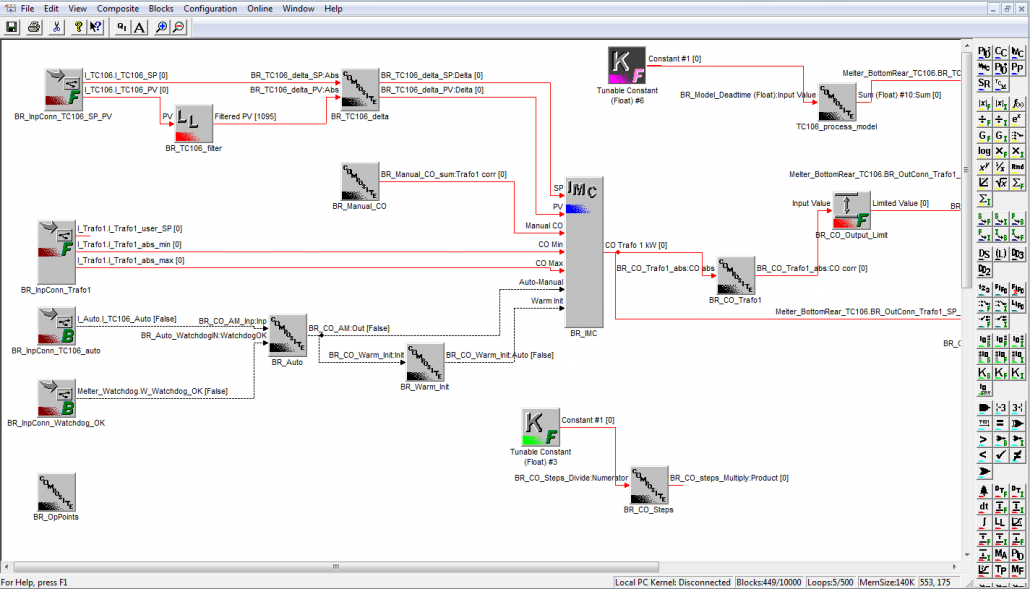
MANTRA 47 provides application developers with an
extensive library of process functions easily accessed from their development workstation
screens. The library provides a process development environment that's useful to beginner
and veteran process engineer alike, providing basic process functions and the complex
control normally associated with more expensive systems.MANTRA 47's function library includes configurable PID strategies for simple feedback, feedforward, ratio and cascade loop control, arithmetic, logical, I/O, and time-based functions. Optional complex control functions including multivariable (internal model-based) control are also available, enabling you to more fully control your applications. MANTRA 47 also accommodates interlock control within its library of sequential and logical functions. First-time MANTRA 47 system users will appreciate the ease with which they interact with MANTRA 47's intuitive editor and how quickly they can begin generating a broad range of control configurations. Development is easily accomplished by dragging the appropriate process symbols onto the development screen, then logically connecting inputs and outputs to create a control strategy.
|
|||||||||||||||||
| Watch Windows and Faceplates Provide Commissioning and Runtime Tools | The MANTRA 47 system further simplifies startup by providing
developers with configurable watch windows and runtime operator faceplates. Watch windows
are configurable data-monitoring-type screens that are used in conjunction with MANTRA 47
configuration software. These watch windows enable developers to selectively monitor or
interact with any parameter in the system application. Since watch windows provide runtime data about the process, they can be used to help diagnose the integrity of field wiring, I/O modules, and field devices prior to commissioning the system. It is possible to monitor and control simple applications using only watch windows. For more complex applications requiring a HMI workstation, MANTRA 47's ActiveX operator faceplates are easily integrated with ActiveX-compliant HMI software packages helping reduce the development time normally required to create custom runtime operator screens. A built-in tag export function for RSView 32 simplifies HMI configuration.
|
||||||||||||||||
| Integration Within Allen-Bradley Architecture | |||||||||||||||||
| MANTRA 47: A Scalable Stand-Alone Process Controller | The MANTRA 47 system is based on one of
Allen-Bradley's newest control platforms, the 1747-OC Open Controller. The new system
combines the attributes of an open architecture with A-B technology and reliability to
provide a flexible, software-enabled control platform. It provides a high level of
performance and deterministic I/O response from its built-in scanner, and is highly
reliable since it is based on rugged, industrialized packaging using field-proven
Allen-Bradley chassis, power supply, and I/O products. |
||||||||||||||||
| SLC Family of Products | Applications can be expanded by adding off-the-shelf Allen-Bradley 1746 local and 1771 remote I/O modules. If you've traditionally bypassed the programmable controller for your process requirements, for whatever reason, the MANTRA 47 system may be your ideal introduction to using rugged, cost-effective components and a new level of process control capability. | ||||||||||||||||
| MANTRA 47 Controller: A Networkable Process Controller | Although the MANTRA 47 controller is an extremely capable process
controller, we developed it to be compatible with other Allen-Bradley control systems. Historically, only process integrators well-versed in relay ladder logic were likely to install a PLC controller to control the actual process. Therefore, most developers were forced to integrate loop or process controllers with programmable controllers, often requiring custom drivers and gateways for communication. With the MANTRA 47 system, however, communication with the PLC is fully integrated. While a PLC is controlling the sequencing, the MANTRA 47 system works seamlessly with the PLC to control the actual process. |
||||||||||||||||
| Changing the Traditional Architecture | The MANTRA 47 system provides developers with an alternative
to loop controllers and micro-DCS type of process control systems, allowing them to use
Allen-Bradley controls for the process itself. If your processes already use Allen-Bradley programmable controllers for discrete control, investing in MANTRA 47 will extend the power of your existing architecture by adding powerful process control. If you are a new user, MANTRA 47 will open up a whole new world of truly advanced process control on a PLC form factor. As you begin controlling your processes with the MANTRA 47 advanced process control system, you may want to take a closer look at whose programmable controller you use to control the raw and finished goods portion of your application. Because, quite simply, nothing integrates more easily with the MANTRA 47 advanced process control system than A-B's programmable logic controllers. |
||||||||||||||||
| Reference Documents | |||||||||||||||||
|
|||||||||||||||||
| For more information about MANTRA 47, use our Contact Form. | |||||||||||||||||
![]() |
|
|
|
|